Love Burn 2027 application · prepared September 30, 2026
A moon you can move with your body.
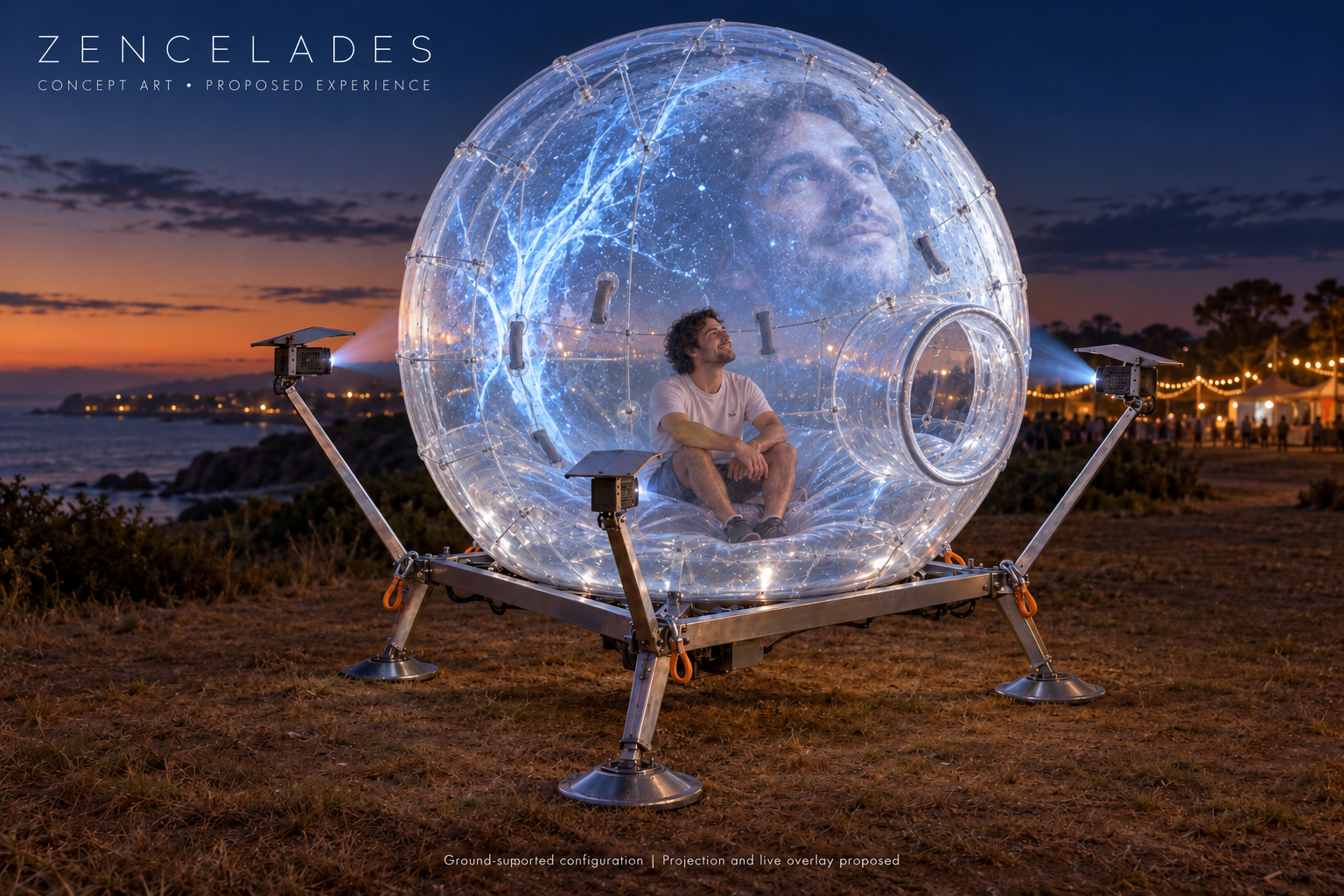
A 2.5 m walk-in zorb, lightly frosted, stands on lander legs or hangs at eye level from the artist’s own aerial rig. Two 3,600-lumen projectors paint it with fractured ice, the hidden ocean and its plumes. Climb in through the tunnel, sit on the soft floor, say “I am the man on the moon” (or woman, or whatever you are), and two cheap phone cameras inside put you on it: your live face, blown up to the size of the moon, fades in under the ice, the ice fractures around you, the hidden ocean floods through, plumes rise from where you sit, and the moon slowly takes itself back. Haze in the air outside makes the beams visible. One person inside at a time, a crew member at the tunnel, a switch at the door and a stop switch at the seat.
These schematics are the Tier 1 build for the application: one person inside at a time, dry land, projectors on stands, no engineering beyond a fabricated steel triangle and an aerial rig used within its manual. The concept art shows the one-unit upgrade with projector heads on arms from the triangle; the over-water version remains a future ambition with its own approvals.
The landed state. Generated concept art, October 2026: one person inside the moon, their live face across its surface, the triangle holder on its lander legs. The projector heads on arms are the one-unit upgrade; the 2027 build puts the projectors on stands, as the plates below show. A second piece of concept art shows the same holder hung.
Plate 1 · The hung version.
What the committee is funding. Sphere centre at 1.7 m so a seated viewer sees it whole; projectors 4 m out on each side, matched to the Optoma HD146X throw ratio; the blower runs continuously; the Pi and power box sit behind projector B.
Does it fit the rig?
Needed attachment height = sphere + 0.3 m ground gap + 0.6 m bridle + 0.2 m hardware + 0.3 m movement. The sphere must also pass between the sloping legs at its widest point.
Largest sphere by rig height
Rig nominal
Attachment height
Largest sphere by height
2.5 m sphere
12 ft
3.66 m
2.2 m
no · use 2 m
16 ft
4.88 m
3.4 m
yes, 1 m spare
20 ft
6.10 m
4.7 m
yes
Andrew’s own rig model decides this row. Its manual, not this table, sets the load and wind limits.
Hanging it: the sphere side and the support side
The moon is the zorb. A TPU zorb weighs tens of kilograms (a 3 m one 80 to 100 kg) and has no rated top point, so nothing hangs from its skin: it seats in a padded steel loop at the centre of a fabricated triangle, lifts on a three-line bridle through a rated swivel, and a hand winch with a brake on the rig leg does the raising and lowering. Its skin has to diffuse light, frosted or white or with a diffusing liner; the October bench test proves that before anything else is bought.
Cheap static metal, done right, is a lighting goalpost. Two 14 ft ProX crank stands (220 lb each, TUV certified, about $316 to $400 each on sale) and a 10 ft truss span make a rated, resellable goalpost that fits in the truck and cranks the moon down in wind in a minute: $1,010 to $1,824 with contingency, artist-funded, used only if the owned rig fails the fit check. A custom weld costs about the same, is rated by nobody and cannot be lowered.
Plates 2 and 3 · A tree, or the ground.
Same artwork, different hook. A tree is a candidate only with the event’s written permission for that tree. The research page explains why a healthy branch is not a free rated anchor.The landed state. The same triangle on three pinned legs: centre at the same 1.7 m, top just under 10 ft, tunnel at knee height, blower on, a crew member at the door. This is where people go inside, and the whole piece if no rig is allowed.
If something is not allowed.
No aerial rig or truss
The moon lands. Three pinned legs on the steel triangle stand it like a landed probe (NASA’s Enceladus concept is an Orbilander) with its centre at the same 1.7 m and its top just under 10 ft: same projectors, same cameras, same show, nothing overhead, nothing to climb, sandbags on the foot pads. The landing can also be the nightly show beat.
The truck
Transport only: it unloads at the placement and parks at Miami Marine Stadium like any car; the kit is hand-carried in one trip with three people. Parking it at the camp as scenery is a later option, not part of the 2027 ask. What Love Burn allows.
No event power
An inverter generator under 5,000 W at the artist’s cost, or a battery station for intermittent nights.
No haze
The piece runs without it; the beams are a bonus.
No tree, no shoreline
Never assumed; rig or lander legs on dry land.
Wind
Lowered and strapped in a minute; above the second limit, deflated and covered for the night.
Plate 6 · Lowering the moon.
Lower it, don’t drop it. To lower: unclip the safety sling, uncleat and ease the halyard 0.25 m until the sphere sits on the cradle, cleat off, strap the two lower rings to the sandbags. To raise: reverse. Parts are in the rigging kit: a hand winch with a brake on the rig leg (a boat-trailer winch is the cheap one), a block at the top bar, rated rope sized for the zorb, a rated swivel, carabiners. The swivel is lyra-style on purpose: the image is projected, so the moon can turn under it and the picture stays put; tag lines only damp swing. A pair of porch-swing springs above the swivel makes it bob gently if we want that. A crank-stand goalpost does the same job with its crank.
Plate 4 · Signal and power.
No internet, no stored images, one circuit. The phones only see the seat, and the image exists only on the moon while someone sits there. The host keeps a calm loop running if a phone drops, and the physical shutdown (lower, cover, unplug) is independent of the software.
Plate 5 · Footprint.
Where things go. The tunnel faces north, where the queue and the crew member stand; the south side is the widest view, and nobody walks through a beam. The projectors’ backs face east and west, so spill onto neighbours is minimal.
Ledger and the ask.
What a Love Burn grant usually is
From Love Burn’s own finance disclosures: LB2024 paid $440,092 in cash art grants across 210 projects, about $2,096 per project; LB2023 paid $387,071 across 149, about $2,598. (The 2026 and 2025 links on that page currently open the 2024 and 2023 files.)
The form sorts requests into tiers: Spark to $599, Seed $600 to $3,000 for “simple to medium builds, portable art, or small interactive pieces”, Feature $3,000 to $15,000, Anchor above. Ask: $3,000 cash as a Seed Grant, plus 3 crew tickets and one power circuit, itemised against the Tier 1 list. It covers the low build in full; the artist covers the rest and every in-kind line.
What the artist brings
Aerial rig
Owned. Model and height to confirm; sets the fit row above.
Hazer
Owned. Still-air beams; fluid is a consumable.
Laptop and UniFi router
Owned. The laptop composites the live feeds in real time; the router makes the private, internet-free network.
Truck
2021 Ram 2500 for transport only; carries no load and is not part of the 2027 art.