Engineering research · September 30, 2026
How to hold
a moon.
A simpler support can preserve the feeling of a floating world. Start with a stationary, unoccupied object on dry land. Prove the image on a small ground-supported surface, then decide whether suspension earns its cost.
Read the complete technical brief Optics, water and experience research
Concept comparisons and planning allowances. These are not approved structures or human-bearing designs.
The truck can stay.
The complicated boom can go.
- Lowest-cost starting point
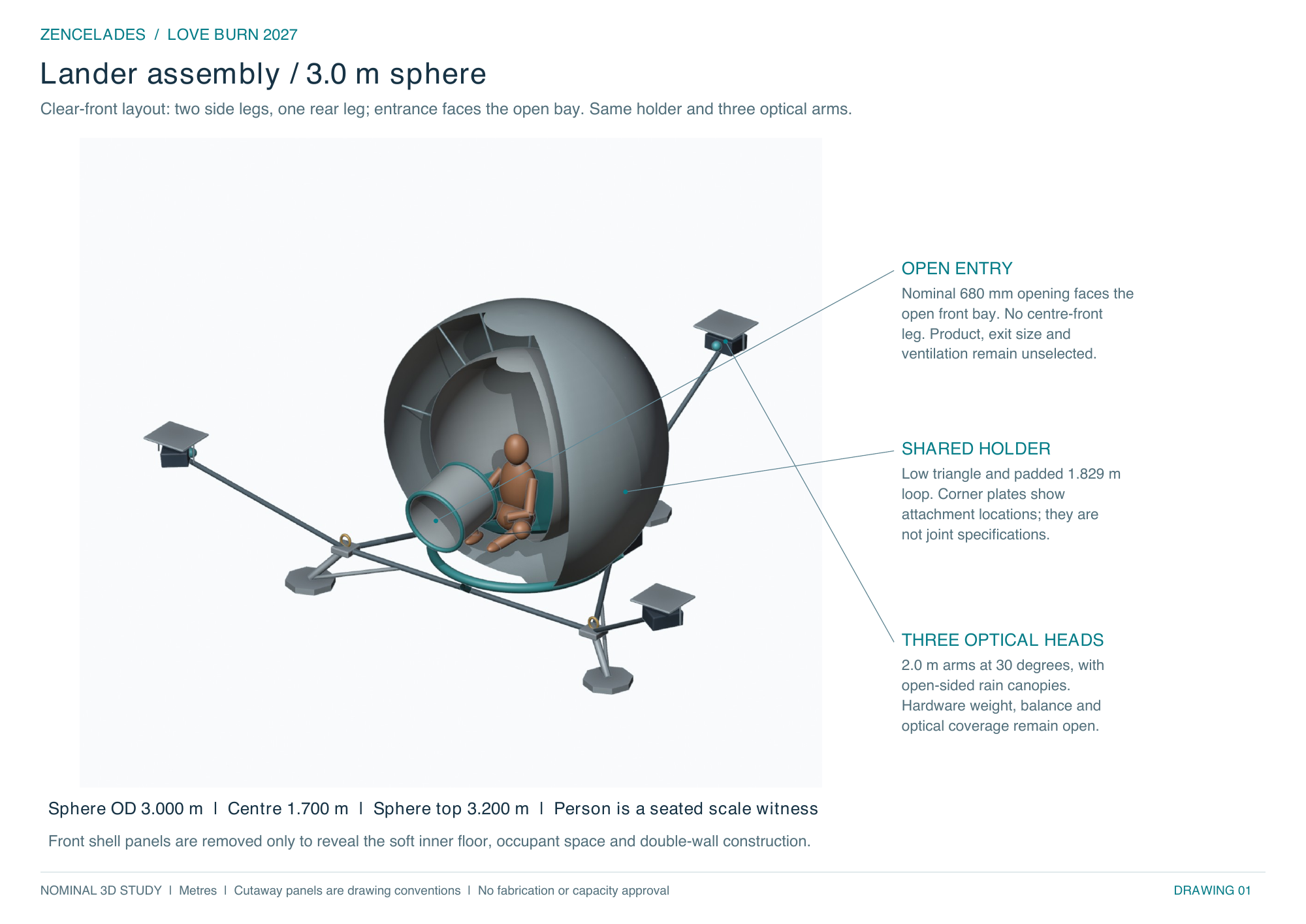
- A low cradle or hemisphere. A smaller moon keeps the experience visible while reducing support height, wind area and the surface to illuminate.
- Best truck-related comparison
- A ground-bearing portal beside the parked truck. Quote it against a complete freestanding rig; the truck can remain transport and scenery.
- Fixed truck mount
- A short chassis-mounted mast removes telescoping and articulation. The vehicle interface, reach and overturning analysis remain real costs.
- Receiver crane
- A commercial hitch crane with its own stabilizer leg is a material-handling option. A tow rating does not establish an overhead scenic rating.
- Tree or existing structure
- A candidate only after the owner and specialists accept the exact site, object and load directions.
The approximately $190 truck-bed crane is not the price of a show installation. Its reach is shorter than the original globe’s radius. Installation and suitability remain separate.
Aerial rigs: check the space
inside the legs.
Illustrative height budget: 3.4 m globe + 0.3 m ground gap + 0.6 m bridle + 0.2 m hardware + 0.3 m movement allowance = 4.8 m. These are comparison assumptions, not safe-clearance specifications.
A 12-foot rig is too short for that example. A nominal 16-foot rig has almost no spare height. A 20-foot rig deserves a proper fit study, including its actual attachment point, sloping legs, suspension assembly and audience footprint.
A small training frame
The X-POLE documentation rules it out for the original full-size concept on geometry and intended-use grounds. A headline weight rating cannot resolve either.
A taller documented rig
JuggleGear MK3 starts at CAD 3,095; ACHILLE displays CAD 3,999 before configuration and extras. Both need manufacturer review for the globe and its wind exposure.
The suspension chain
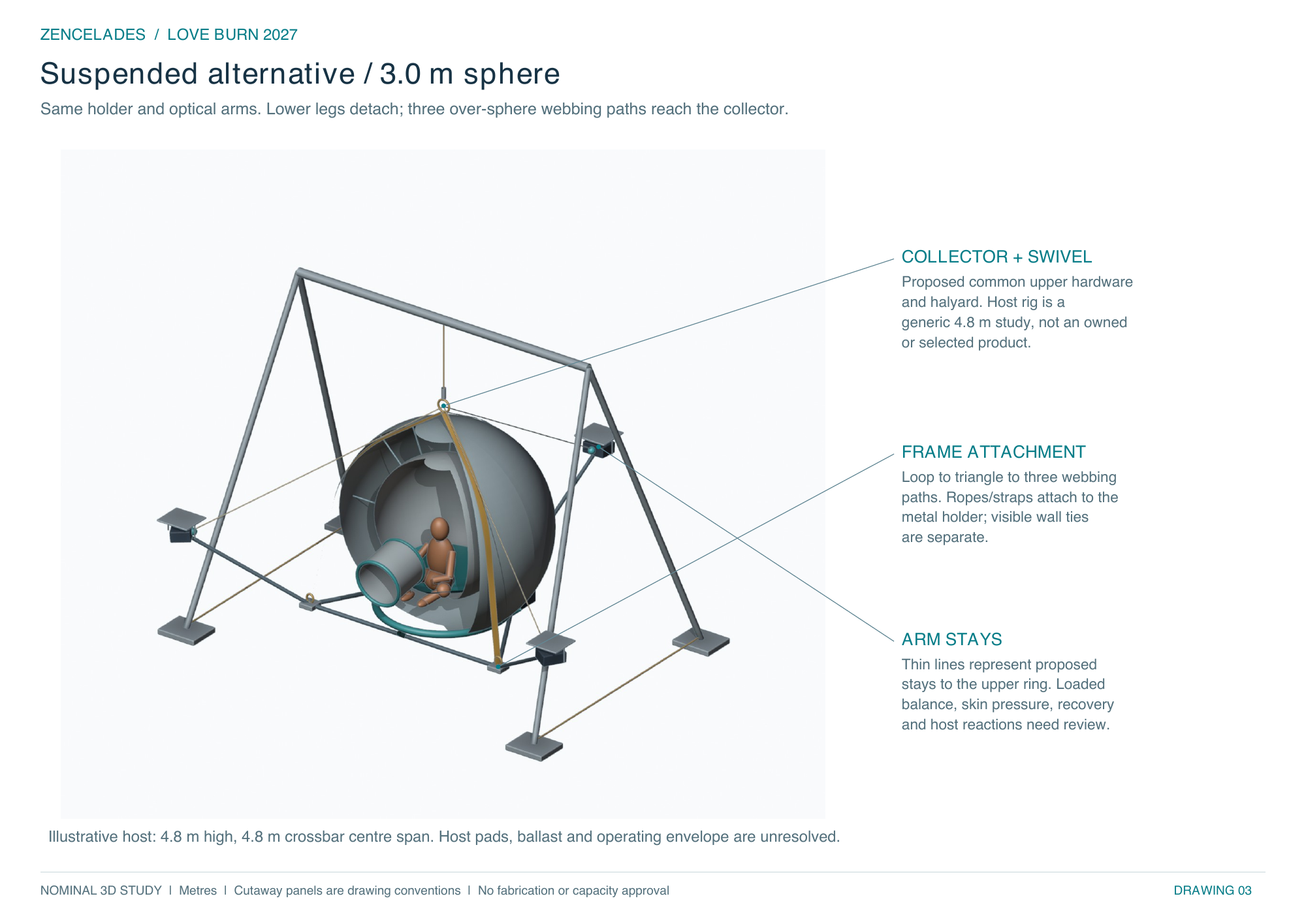
Assessed support → compatible suspension hardware → a sphere-specific spreader or cradle → the unoccupied scenic object. Handles and inflation fittings are not established lifting points. A rigger specifies the raising/lowering method, retention, inspections and recovery.
Keep projector supports separate where practical. Sphere motion otherwise changes both loading and image registration. No internal cameras are needed for a prerecorded moon/ocean loop or an external visitor control.
A tree is a living structure.
It needs its own assessment.
Uplift’s tree guidance calls for an arborist and an experienced rigger. Hidden damage, the particular limb or union, roots, load direction and changing condition matter. Two trees and a nearly horizontal line can increase anchor forces dramatically.
Love Burn addresses damage to flora and park infrastructure. That is not permission to use a particular tree. Obtain a written site decision; do not assume straps, stakes, drilling or pruning are allowed.
The tree option may save frame material and still cost more after assessment, rigging, protection and inspection. Keep a complete ground-supported fallback in the proposal.
Compare installed support costs.
USD planning allowances before tax and contingency. They exclude the sphere, projection, content, general event transport, insurance and human occupancy. They are not vendor quotes or additions to an already complete support line in the pricing workbench.
- Small ground cradle
- $1,100–3,600 including support fabrication, review and ground/install allowance.
- Truck-adjacent ground portal
- $2,700–8,500. The most promising custom alternative to compare with a bought rig.
- Fixed truck cantilever
- $4,500–13,000. Custom vehicle integration can outweigh the savings from removing moving parts.
- Tall freestanding rig
- $4,800–13,700 including suspension, ground interface and review. Request a local rental package as a separate comparison.
- Approved tree, light unoccupied prop
- $2,000–7,300. Site acceptance is uncertain and assessment costs may be incurred before rejection.
A smaller moon changes
more than its price.
A 2 m sphere has about 35% of the frontal area of the 3.4 m concept. That reduces the area exposed to wind and the surface to illuminate. Removing water, motion and internal capture further reduces separate engineering problems.
The technical brief includes a clearly labelled wind sensitivity example, fit calculations, five truck layouts, source limitations and a five-part quotation brief. It distinguishes working load from breaking strength and identifies current ESTA standard editions without claiming certification.
Complete mount research · Dated source register · Broader engineering research
No hardware has been purchased, no rig has been built and no venue or manufacturer has approved this installation.